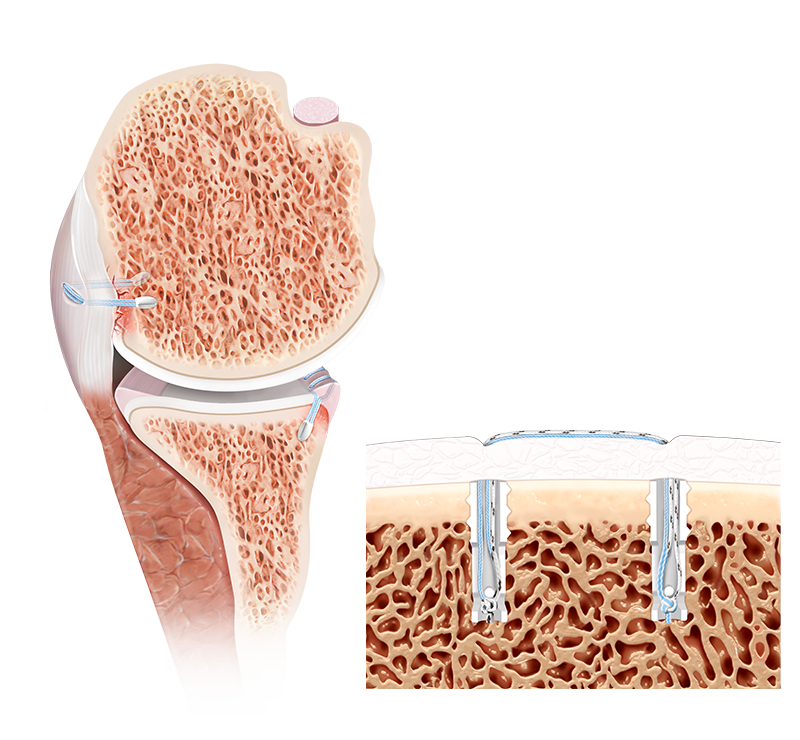
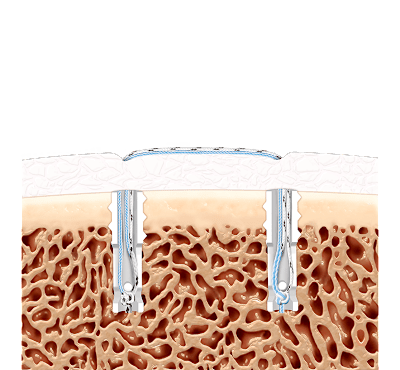
Remplissage Technique for Shoulder Instability: Knotless FiberTak® Soft Anchors
Remplissage has become an increasingly common adjunct to arthroscopic Bankart repair for patients with anterior shoulder instability and Hill-Sachs lesions. By addressing humeral-sided bone defects and reducing lesion engagement, remplissage can improve stability while preserving native anatomy. This page reviews applications, glenoid track concepts, clinical outcomes, patient selection considerations, cost-effectiveness evidence, and surgical technique resources.
What Is Remplissage?
Remplissage is an arthroscopic procedure performed in conjunction with Bankart repair to address bipolar bone loss in patients with anterior shoulder instability. The technique converts the Hill-Sachs defect into an extra-articular lesion by securing the posterior capsule and infraspinatus tendon into the defect, helping to reduce engagement and recurrent instability.1,2
When May Remplissage Be Appropriate?
• Recurrent anterior shoulder instability3,4
• Varying degrees of on-track, near-track, and off-track Hill-Sachs lesions, depending on other patient risk factors1,2
• Subcritical glenoid bone loss5,6
• High-risk instability patients (ie, contact athletes, soft-tissue laxity)7,8
What Is an On-Track Hill-Sachs Lesion?
• Remains within the glenoid track—the area of the humeral head that normally articulates with the glenoid during shoulder motion—and is therefore less likely to engage the anterior glenoid rim, reducing the risk of recurrent instability1,3
• Often managed successfully with arthroscopic Bankart repair1,3
• Remplissage may not be required when glenoid bone loss is minimal1
What Is a Near-Track Hill-Sachs Lesion?
• Lies close to the threshold between on-track and off-track lesions9
• May represent a higher-risk subgroup despite technically being on-track9
• More likely to engage when combined with subcritical glenoid bone loss, high-demand/contact athletics, ligamentous laxity, or recurrent instability episodes7-9
• May prompt consideration of remplissage in addition to Bankart repair to further reduce recurrence risk7,9
What Is an Off-Track Hill-Sachs Lesion?
• Extends beyond the glenoid track—the area of the humeral head that normally remains in contact with the glenoid during shoulder motion—making the lesion more likely to engage the anterior glenoid rim and increasing the risk of recurrent instability and dislocation1,3
• Often requires treatment of the humeral-sided defect in addition to labral repair2
• In patients with minimal to subcritical glenoid bone loss, remplissage is commonly added to Bankart repair to improve stability and reduce recurrence risk2,10,11
• In the presence of substantial glenoid bone loss, a bone augmentation procedure such as Latarjet may be more appropriate than remplissage alone1,12
Remplissage vs Latarjet
Remplissage and the Latarjet procedure are both effective surgical options for managing anterior shoulder instability, but the choice between procedures is driven by patient-specific factors, including glenoid bone loss, Hill-Sachs lesion characteristics, activity demands, and recurrence risk.12,13
Remplissage is associated with low recurrence rates, high return-to-sport rates, and preservation of native anatomy, making it a valuable option for patients with Hill-Sachs lesions and subcritical glenoid bone loss.11,13,14 Latarjet provides reliable long-term stability, particularly in patients with substantial glenoid bone loss, high-risk instability patterns, or failed prior stabilization procedures.12,13 While both procedures effectively restore shoulder stability, remplissage generally has a lower complication profile, whereas Latarjet is more technically demanding and may be associated with graft-, hardware-, and neurovascular-related complications, as well as graft nonunion, malposition, or revision surgery.12-14
What Are the Clinical Outcomes of Remplissage?
• Lower rates of recurrent instability4,10,11,14
• Reduced risk of redislocation compared with isolated Bankart repair in appropriately selected patients4,10,11
• High rates of return to sport and physical activity4,7,13
• Significant improvements in patient-reported outcome measures7,10
• Durable mid- and long-term clinical results4,7,11
Does Remplissage Affect Shoulder Motion?
One of the most common concerns regarding remplissage is potential loss of external rotation due to fixation of the posterior capsule and infraspinatus tendon. While some studies have reported small decreases in external rotation, most have found these changes to be clinically acceptable and not associated with meaningful functional limitations.7,14
What Is the Cost-Effectiveness of Remplissage?
Adding remplissage to Bankart repair provides both clinical and economic benefits by reducing recurrent instability and the need for revision surgery. Economic modeling has shown that patients who undergo Bankart repair with remplissage experience more quality-adjusted life years (QALYs) over time compared with isolated Bankart repair, while the additional upfront surgical costs remain relatively small.15,16
Adding remplissage to Bankart repair may be cost-effective because it can:
• Reduce recurrent instability15
• Reduce the need for revision surgery15
• Improve long-term QALYs15
• Deliver economic value through prevention of relatively few recurrence events over time15
These findings suggest that the benefits of preventing recurrence may outweigh the additional procedural costs in appropriately selected patients.
Advantages of a Knotless Remplissage Surgical Technique
This technique uses Knotless FiberTak® soft anchors to create interconnected, tensionable fixation of the posterior capsule and infraspinatus tendon within the Hill-Sachs defect. The potential advantages include simplified tensioning, no risk of knot migration or loosening, and reproducible fixation.2,17
References
1. Di Giacomo G, Itoi E, Burkhart SS. Evolving concept of bipolar bone loss and the Hill-Sachs lesion: from “engaging/non-engaging” lesion to “on-track/off-track” lesion. Arthroscopy. 2014;30(1):90-98. doi:10.1016/j.arthro.2013.10.004
2. Hartzler RU, Bui CN, Jeong WK, et al. Remplissage of an off-track Hill-Sachs lesion is necessary to restore biomechanical glenohumeral joint stability in a bipolar bone loss model. Arthroscopy. 2016;32(12):2466-2476. doi:10.1016/j.arthro.2016.04.030
3. Shaha JS, Cook JB, Rowles DJ, Bottoni CR, Shaha SH, Tokish JM. Clinical validation of the glenoid track concept in anterior glenohumeral instability. J Bone Joint Surg Am. 2016;98(22):1918-1923. doi:10.2106/JBJS.15.01099
4. Woodmass JM, McRae S, Lapner P, et al. Arthroscopic Bankart repair with remplissage in anterior shoulder instability results in fewer redislocations than Bankart repair alone at medium-term follow-up of a randomized controlled trial. Am J Sports Med. 2024;52(8):2055-2062. doi:10.1177/03635465241254063
5. Arciero RA, Parrino A, Bernhardson AS, et al. The effect of a combined glenoid and Hill-Sachs defect on glenohumeral stability: a biomechanical cadaveric study using 3-dimensional modeling of 142 patients. Am J Sports Med. 2015;43(6):1422-1429. doi:10.1177/0363546515574677
6. Lin A, Barrow AE, Charles S, et al. Remplissage reduces recurrent instability in high-risk patients with on-track Hill-Sachs lesions. J Shoulder Elbow Surg. 2023;32(6S):S99-S105. doi:10.1016/j.jse.2023.02.011
7. Garcia GH, Wu HH, Liu JN, Huffman GR, Kelly JD 4th. Outcomes of the remplissage procedure and its effects on return to sports: average 5-year follow-up. Am J Sports Med. 2016;44(5):1124-1130. doi:10.1177/0363546515626199
8. Domos P, Ascione F, Wallace AL. Arthroscopic Bankart repair with remplissage for non-engaging Hill-Sachs lesion in professional collision athletes. Shoulder Elbow. 2019;11(1):17-25. doi:10.1177/1758573217728414
9. Li RT, Kane G, Drummond M, et al. On-track lesions with a small distance to dislocation are associated with failure after arthroscopic anterior shoulder stabilization. J Bone Joint Surg Am. 2021;103(11):961-967. doi:10.2106/JBJS.20.00917
10. MacDonald P, McRae S, Old J, et al. Arthroscopic Bankart repair with and without arthroscopic infraspinatus remplissage in anterior shoulder instability with a Hill-Sachs defect: a randomized controlled trial. J Shoulder Elbow Surg. 2021;30(6):1288-1298. doi:10.1016/j.jse.2020.11.013
11. Ahmed AF, Polisetty TS, Wang C, et al. Higher return to sport and lower revision rates when performing arthroscopic Bankart repair with remplissage for anterior shoulder instability with a Hill-Sachs lesion: a meta-analysis. J Shoulder Elbow Surg. 2024;33(8):1836-1846. doi:10.1016/j.jse.2024.01.045
12. Haroun HK, Sobhy MH, Abdelrahman AA. Arthroscopic Bankart repair with remplissage versus Latarjet procedure for management of engaging Hill-Sachs lesions with subcritical glenoid bone loss in traumatic anterior shoulder instability: a systematic review and meta-analysis. J Shoulder Elbow Surg. 2020;29(10):2163-2174. doi:10.1016/j.jse.2020.04.032
13. Horinek JL, Menendez ME, Narbona P, Lädermann A, Barth J, Denard PJ. Remplissage yields similar 2-year outcomes, fewer complications, and low recurrence compared with Latarjet across a wide range of preoperative glenoid bone loss. Arthroscopy. 2022;38(10):2798-2805. doi:10.1016/j.arthro.2022.03.031
14. Tansey PJ Jr, Clark DS, Ruelos VCB, Lindeman RW, Somerson JS. Arthroscopic Bankart repair with remplissage results in low recurrent instability rates without reducing shoulder range of motion at midterm follow-up: a systematic review of studies with minimum 5-year outcomes. Am J Sports Med. 2025;53(14):3521-3527. doi:10.1177/03635465251324930
15. Frederickson M, Kou M, Cullinane D, Menendez ME. Cost-effectiveness of adding remplissage to Bankart repair for on-track Hill-Sachs lesions: a Markov decision analysis. Am J Sports Med. 2026;54(9):2232-2243. doi:10.1177/03635465261444008
16. Schreiner G, Fucaloro S, Hayes-Lattin M, Bragg J, Salzler MJ. Remplissage during primary arthroscopic Bankart repair is highly cost-effective for off-track Hill-Sachs lesions and variably cost-effective for on-track Hill-Sachs lesions with glenoid bone loss below 15%. Arthroscopy. 2025;41(11):4483-4490. doi:10.1016/j.arthro.2025.06.021
17. Funakoshi T, Hartzler RU, Stewien E, Burkhart SS. Remplissage using interconnected knotless anchors: superior biomechanical properties to a knotted technique? Arthroscopy. 2018;34(11):2954-2959. doi:10.1016/j.arthro.2018.06.030