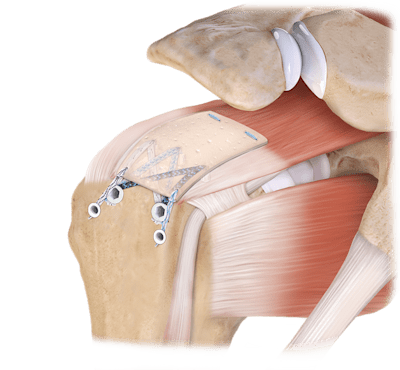
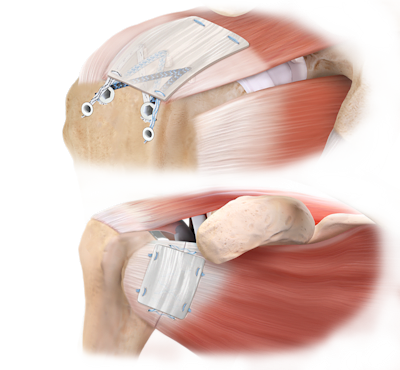
Approximately 20% of patients experience failed healing after primary rotator cuff repair, with up to 86% of failures occurring at the suture–tendon interface.1,2 Augmentation of rotator cuff repairs may improve biomechanical strength and tendon healing rates.3-6 The CuffMend™ technique provides a simplified technique for augmenting the rotator cuff using human dermal allograft, autograft biceps tendon, or SuturePatch tissue reinforcement.
References
1. Kwon J, Kim SH, Lee YH, Kim TI, Oh JH. The Rotator Cuff Healing Index: a new scoring system to predict rotator cuff healing after surgical repair. Am J Sports Med. 2019;47(1):173-180. doi:10.1177/0363546518810763
2. Cummins CA, Murrell GA. Mode of failure for rotator cuff repair with suture anchors identified at revision surgery. J Shoulder Elbow Surg. 2003;12(2):128-133. doi:10.1067/mse.2003.21
3. Barber FA, Burns JP, Deutsch A, Labbé MR, Litchfield RB. A prospective, randomized evaluation of acellular human dermal matrix augmentation for arthroscopic rotator cuff repair. Arthroscopy. 2012;28(1):8-15. doi:10.1016/j.arthro.2011.06.038
4. Bailey JR, Kim C, Alentorn-Geli E, et al. Rotator cuff matrix augmentation and interposition: a systematic review and meta-analysis. Am J Sports Med. 2019;47(6):1496-1506. doi:10.1177/0363546518774762
5. Omae H, Steinmann SP, Zhao C, et al. Biomechanical effect of rotator cuff augmentation with an acellular dermal matrix graft: a cadaver study. Clin Biomech (Bristol, Avon). 2012;27(8):789-792. doi:10.1016/j.clinbiomech.2012.05.001
6. Gilot GJ, Alvarez-Pinzon AM, Barcksdale L, Westerdahl D, Krill M, Peck E. Outcome of large to massive rotator cuff tears repaired with and without extracellular matrix augmentation: a prospective comparative study. Arthroscopy. 2015;31(8):1459-1465. doi:10.1016/j.arthro.2015.02.032