PARS Achilles Jig System
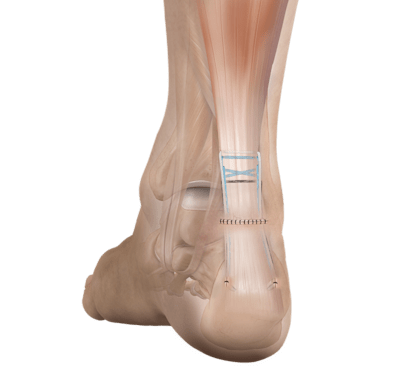
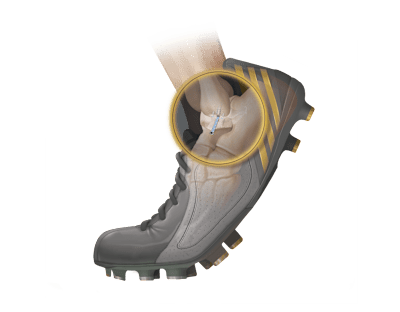
Achilles tendon ruptures are common in the elite and recreational athlete and most often occur in the noninsertional region of the tendon complex. Most surgeons will elect to treat these injuries surgically, to lessen the risk for re-rupture,1 while providing the opportunity for a quicker recovery and convenient rehabilitation.2 Historically, open techniques have been used to repair the the rupture, but they can be complicated by wound-healing issues and infection.2 This percutaneous and minimally invasive technique minimizes this concern.2 PARS provides the opportunity for consistently reliable capture of the proximal and distal aspects of the Achilles tendon using color-coded SutureTape or FiberWire® suture.
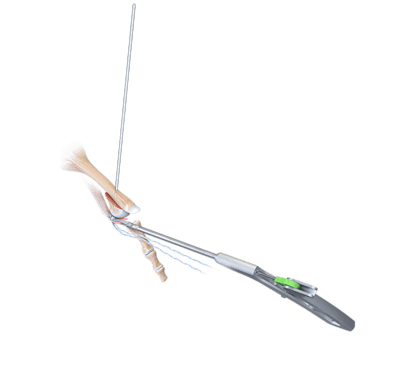
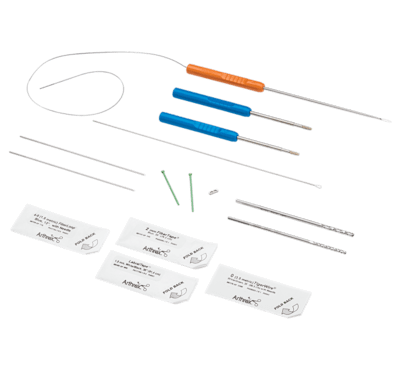
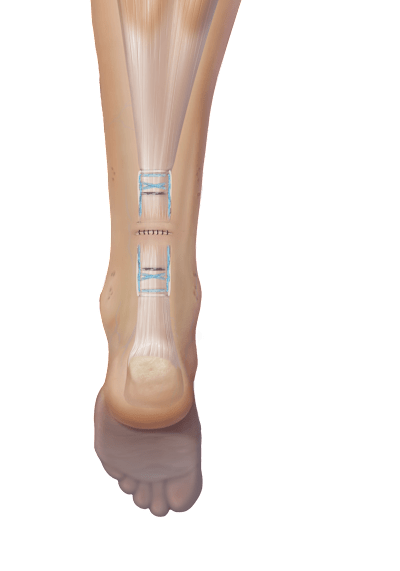
The anatomically contoured guide is nondisposable, while the suture and passing needles come packaged in one convenient kit. The system provides the option to use transverse or locking sutures, or both. Using the locking option, a locked SutureTape or FiberWire suture can be incorporated on both ends of the ruptured tendon. This results in a stronger repair than just passing transverse sutures across the tendon like other minimally invasive devices on the market.3
The colored sutures offer a more organized approach to identifying and securing matched pairs. The healed tendon achieves a more natural contour, unlike the typical hypertrophic tendon resulting from open repair.4 This minimally invasive technique is ideal for middle-aged patients, where there may be a heightened concern for wound-healing issues.5
Advantages:
• Minimal incision reduces risk of wound complications2
• Provides the ability to create a locking stitch
• Specialized suture kits—8 different colored SutureTape or FiberWire sutures
• Easy suture management
• Reusable device with numbered, easy-to-follow steps
References
1. Khan RJ, Fick D, Keogh A, Crawford J, Brammar T, Parker M. Treatment of acute achilles tendon ruptures. A meta-analysis of randomized, controlled trials. J Bone Joint Surg Am. 2005;87(10):2202-2210. doi:10.2106/JBJS.D.03049
2. Hsu AR, Jones CP, Cohen BE, Davis WH, Ellington JK, Anderson RB. Clinical outcomes and complications of percutaneous Achilles repair system versus open technique for acute Achilles tendon ruptures. Foot Ankle Int. 2015;36(11):1279-1286. doi:10.1177/1071100715589632
3. Demetracopoulos CA, Gilbert SL, Young E, Baxter JR, Deland JT. Limited-open Achilles tendon repair using locking sutures versus nonlocking sutures: an in vitro model. Foot Ankle Int. 2014;35(6):612-618. doi:10.1177/1071100714524550
4. Henríquez H, Muñoz R, Carcuro G, Bastías C. Is percutaneous repair better than open repair in acute Achilles tendon rupture? Clin Orthop Relat Res. 2012;470(4):998-1003. doi:10.1007/s11999-011-1830-1
5. Del Buono A, Volpin A, Maffulli N. Minimally invasive versus open surgery for acute Achilles tendon rupture: a systematic review. Br Med Bull. 2014;109:45-54. doi:10.1093/bmb/ldt029