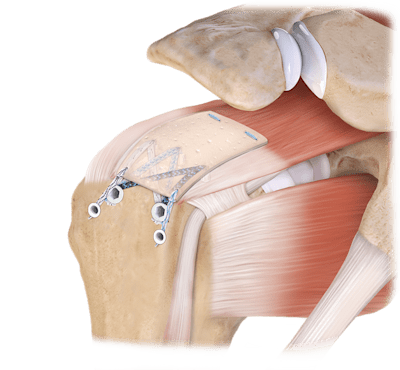
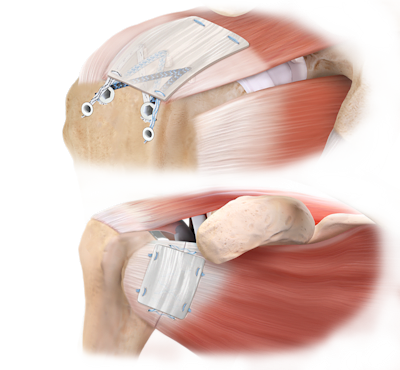
Aproximadamente 20% dos pacientes apresentam falha na cicatrização após o reparo primário do manguito rotador, com até 86% das falhas ocorrendo na interface sutura-tendão.1,2 O reforço dos reparos do manguito rotador pode melhorar a resistência biomecânica e as taxas de cicatrização do tendão.3-6 A técnica CuffMend™ oferece uma técnica simplificada para reforçar o manguito rotador usando aloenxerto dérmico humano, tendão do bíceps autólogo ou reforço de tecido SuturePatch.
Referências
1. Kwon J, Kim SH, Lee YH, Kim TI, Oh JH. The Rotator Cuff Healing Index: a new scoring system to predict rotator cuff healing after surgical repair. Am J Sports Med. 2019;47(1):173-180. doi:10.1177/0363546518810763
2. Cummins CA, Murrell GA. Mode of failure for rotator cuff repair with suture anchors identified at revision surgery. J Shoulder Elbow Surg. 2003;12(2):128-133. doi:10.1067/mse.2003.21
3. Barber FA, Burns JP, Deutsch A, Labbé MR, Litchfield RB. A prospective, randomized evaluation of acellular human dermal matrix augmentation for arthroscopic rotator cuff repair. Arthroscopy. 2012;28(1):8-15. doi:10.1016/j.arthro.2011.06.038
4. Bailey JR, Kim C, Alentorn-Geli E, et al. Rotator cuff matrix augmentation and interposition: a systematic review and meta-analysis. Am J Sports Med. 2019;47(6):1496-1506. doi:10.1177/0363546518774762
5. Omae H, Steinmann SP, Zhao C, et al. Biomechanical effect of rotator cuff augmentation with an acellular dermal matrix graft: a cadaver study. Clin Biomech (Bristol, Avon). 2012;27(8):789-792. doi:10.1016/j.clinbiomech.2012.05.001
6. Gilot GJ, Alvarez-Pinzon AM, Barcksdale L, Westerdahl D, Krill M, Peck E. Outcome of large to massive rotator cuff tears repaired with and without extracellular matrix augmentation: a prospective comparative study. Arthroscopy. 2015;31(8):1459-1465. doi:10.1016/j.arthro.2015.02.032