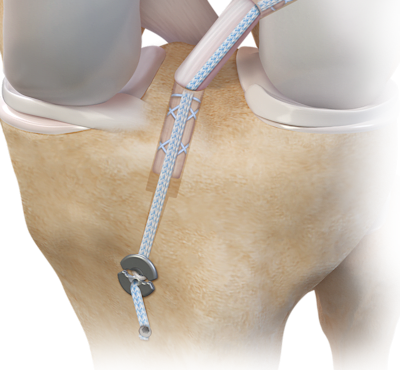
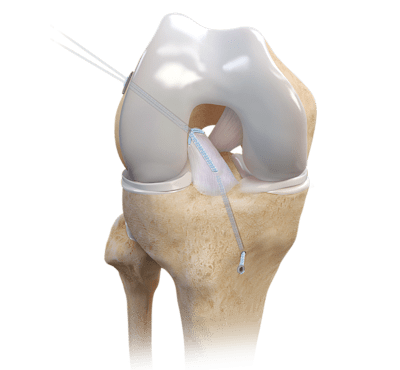
TightRope® SB Implants
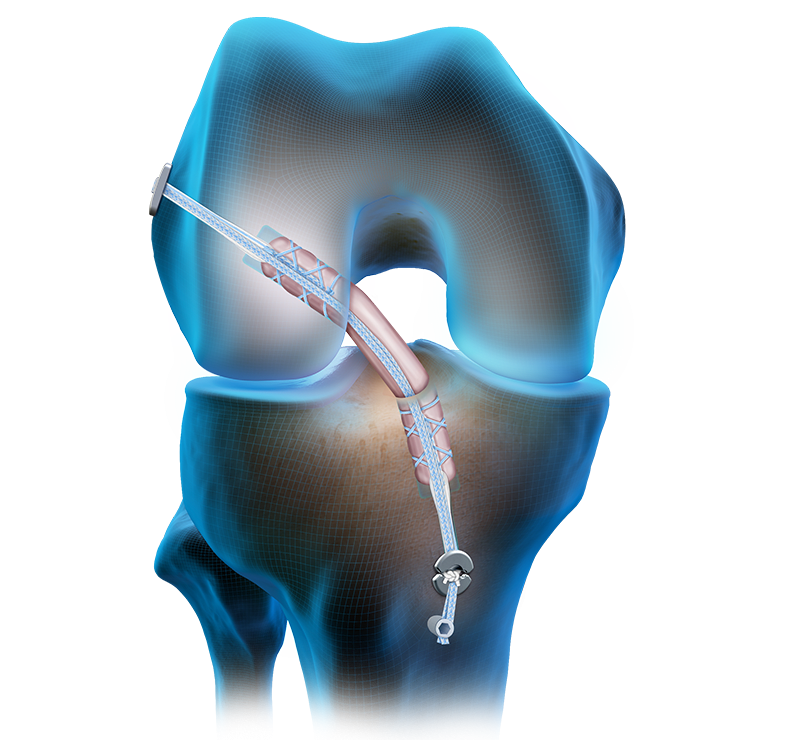
The TightRope SB implant is the ultimate innovation in cortical suspensory fixation, featuring a radiopaque, all-suture cortical button and a minimally invasive, low-profile design that completely eliminates the need for metal implants. Available in FiberTag®, RT, BTB, and repair configurations, these options are also available with preloaded standard or radiopaque FiberTape® suture for the InternalBrace™ technique.
Features and Benefits of the TightRope SB Implant
• Stronger than traditional TightRope implants1 with a minimally invasive, low-profile design
• All-suture button design: Revolutionary all-suture, soft-button technology to eliminate metal from ACL reconstruction
• Ability to reflip: Implant can be reflipped as needed; radiopaque design allows for fluoroscopic confirmation of button deployment
• 1.9 mm flat-tape loop improves graft interface and handling characteristics during graft tensioning and provides greater resistance to graft abrasion2
• InternalBrace technique: Available with preloaded standard or radiopaque FiberTape suture for the InternalBrace technique, proven in peer-reviewed published studies to be associated with lower ACL retear rates at 2 and 5 years,3-6 less pain, improved patient-reported outcomes, and a faster and higher rate of return to preinjury level of activity6,7
• Flat-tape TightRope implant: Offers improved handling characteristics and is more resistant to graft abrasion than traditional round sutures1
• No suture-metal pinch point: Suture-based button offers increased load to failure as compared to a metal button8
• Compatible with existing RetroConstruction™ and TightRope drill pin socket creation techniques
How the TightRope SB Implant Works
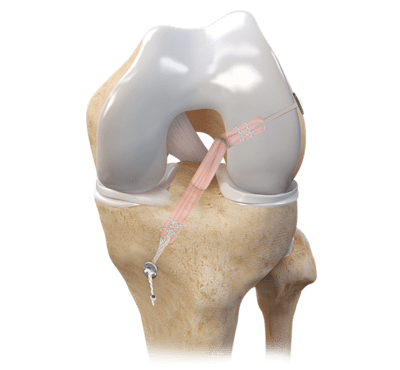
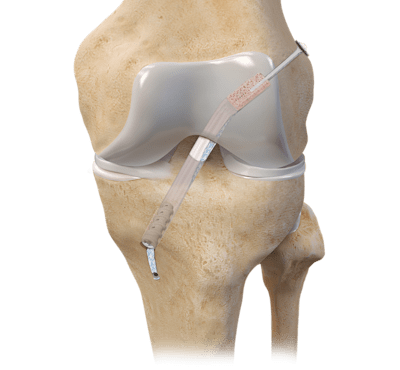
The TightRope SB implant’s unique all-suture design facilitates easy shuttling through the femoral and tibial tunnels, eliminating the need for ABS buttons during all-inside ACL/PCL reconstruction. The technique is identical to existing ACL reconstruction techniques with the only difference between the femoral and tibial implants being the femoral implant comes preloaded with FiberTape suture for the InternalBrace technique.
References
1. Arthrex, Inc. Data on file (APT-07399). Naples, FL; 2026.
2. Arthrex, Inc. LA1-00038-EN_B. Naples, FL; 2017.
3. Daniel AV, Wijdicks CA, Smith PA. Reduced incidence of revision anterior cruciate ligament reconstruction with internal brace augmentation. Orthop J Sports Med. 2023;11(7):23259671231178026. doi:10.1177/23259671231178026
4. Daniel AV, Smith PA. Primary all-soft tissue quadriceps tendon autograft anterior cruciate ligament reconstruction with suture tape augmentation resulted in satisfactory patient outcomes and a low graft failure rate in high school and collegiate athletes. Arthroscopy. 2025;41(1):95-105. doi:10.1016/j.arthro.2024.02.047
5. Wilson WT, Kennedy MJ, MacLeod D, Hopper GP, MacKay GM. Outcomes of anterior cruciate ligament reconstruction with independently tensioned suture tape augmentation at 5-year follow-up. Am J Sports Med. 2023;51(14):3658-3664. doi:10.1177/03635465231207623
6. Daniel AV, Smith PA. Less subsequent revision anterior cruciate ligament reconstruction following primary bone-patellar tendon-bone anterior cruciate ligament reconstruction with suture tape augmentation-a retrospective comparative therapeutic trial with 5-year follow-up. Arthroscopy. 2024;40(9):2455-2464. doi:10.1016/j.arthro.2024.01.019
7. Bodendorfer BM, Michaelson EM, Shu HT, et al. Suture augmented versus standard anterior cruciate ligament reconstruction: a matched comparative analysis. Arthroscopy. 2019;35(7):2114-2122. doi:10.1016/j.arthro.2019.01.054
8. Arthrex, Inc. Data on file (APT-7021). Naples, FL; 2025.
The InternalBrace surgical technique is intended only to augment the primary repair/reconstruction by expanding the area of tissue approximation during the healing period and is not intended as a replacement for the native ligament. The InternalBrace technique is for use during soft tissue-to-bone fixation procedures and is not cleared for bone-to-bone fixation.