Lateral Extra-Articular Tenodesis
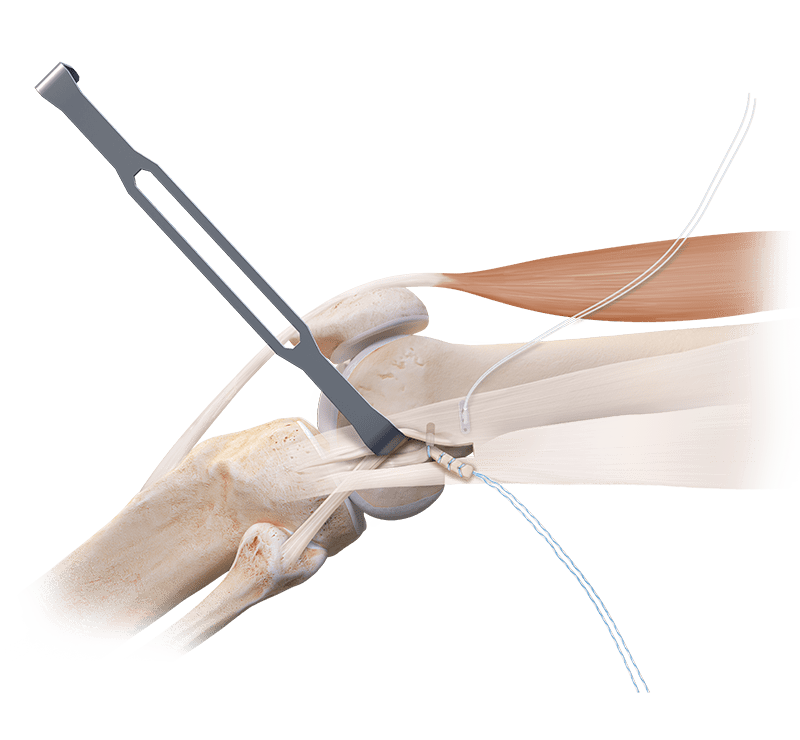
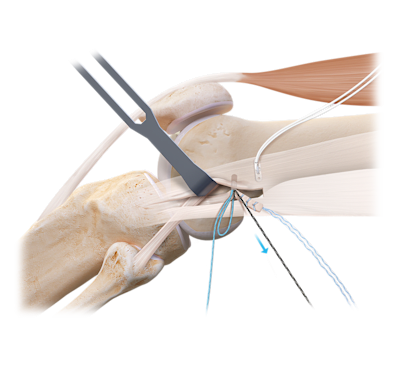
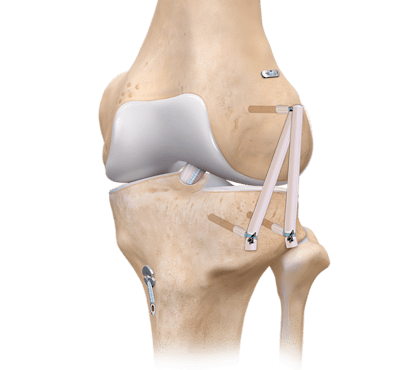
The goal of lateral extra-articular augmentation or reconstruction is to eliminate residual laxity and reduce the risk of ACL graft rupture. Two common techniques include iliotibial band (ITB) tenodesis and anterolateral ligament (ALL) reconstruction. These procedures play a role in augmenting rotational stability in the ACL-reconstructed knee. Patients who see the benefits, include hyperlax patients, revision cases, pivoting athletes, and those with IKDC grade III pivot shifts.
There are several distinct advantages of using adjustable, tensionable implant technology, such as the Knotless FiberTak® anchor or FiberTag® TightRope® implant, when compared to traditional techniques using staples or interference screws:
• Simple: Quick, easy, and reproducible techniques
• Safe: Knotless FiberTak anchor sets just below the cortex, reducing the risk of femoral tunnel convergence of the ACL; the self-punching anchor technique is designed to reduce the risk of damaging the ACL graft as with traditional techniques that require drilling; no risk of graft laceration as described with interference-screw techniques1
• Low profile: Techniques using additional hardware, such as staples, may lead to pain or discomfort, warranting removal; no prominent hardware is part of the Knotless FiberTak anchor or TightRope implant1
• Preserves anatomy: No socket drilling involved in the Knotless FiberTak onlay technique
• Titratable graft tensioning: Using these techniques, a surgeon can provisionally tension and incrementally retension the graft after checking for isometry and overconstraint
Reference
1. Muller B, Willinge GJA, Zijl JAC. Minimally invasive modified Lemaire tenodesis. Arthrosc Tech. 2020;10(1):e29- e36. doi:10.1016/j.eats.2020.09.006