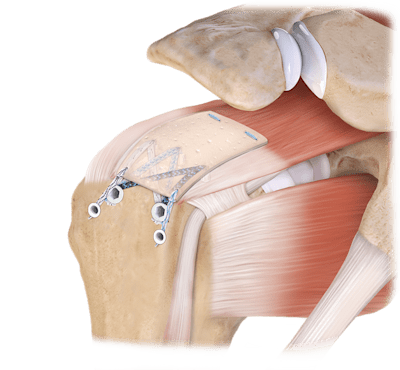
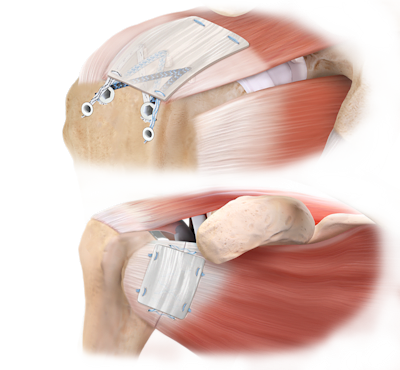
Aproximadamente el 20% de los pacientes experimentan una mala cicatrización después de una reparación primaria del manguito rotador, y hasta el 86% de las fallas ocurren en la interfaz sutura-tendón.1,2 El aumento de las reparaciones del manguito rotador puede mejorar la resistencia biomecánica y las tasas de cicatrización del tendón.3-6 La técnica CuffMend™ proporciona una técnica simplificada para aumentar el manguito rotador utilizando aloinjerto dérmico humano, autoinjerto de tendón del bíceps o refuerzo de tejido SuturePatch.
Referencias
1. Kwon J, Kim SH, Lee YH, Kim TI, Oh JH. The Rotator Cuff Healing Index: a new scoring system to predict rotator cuff healing after surgical repair. Am J Sports Med. 2019;47(1):173-180. doi:10.1177/0363546518810763
2. Cummins CA, Murrell GA. Mode of failure for rotator cuff repair with suture anchors identified at revision surgery. J Shoulder Elbow Surg. 2003;12(2):128-133. doi:10.1067/mse.2003.21
3. Barber FA, Burns JP, Deutsch A, Labbé MR, Litchfield RB. A prospective, randomized evaluation of acellular human dermal matrix augmentation for arthroscopic rotator cuff repair. Arthroscopy. 2012;28(1):8-15. doi:10.1016/j.arthro.2011.06.038
4. Bailey JR, Kim C, Alentorn-Geli E, et al. Rotator cuff matrix augmentation and interposition: a systematic review and meta-analysis. Am J Sports Med. 2019;47(6):1496-1506. doi:10.1177/0363546518774762
5. Omae H, Steinmann SP, Zhao C, et al. Biomechanical effect of rotator cuff augmentation with an acellular dermal matrix graft: a cadaver study. Clin Biomech (Bristol, Avon). 2012;27(8):789-792. doi:10.1016/j.clinbiomech.2012.05.001
6. Gilot GJ, Alvarez-Pinzon AM, Barcksdale L, Westerdahl D, Krill M, Peck E. Outcome of large to massive rotator cuff tears repaired with and without extracellular matrix augmentation: a prospective comparative study. Arthroscopy. 2015;31(8):1459-1465. doi:10.1016/j.arthro.2015.02.032